Our journey to net-zero*
Climate change is one of the most pressing global challenges, posing significant risks to our environment and communities. At GLS, we acknowledge our responsibility in addressing our environmental impact and actively take steps to minimize it.
We are committed to achieving net-zero* across our operations by 2045, in line with the Science Based Targets initiative (SBTi). Our science-based targets (SBTs) guide us in our efforts to gradually cut emissions and ensure our reduction path aligns with global climate objectives.
Science Based Targets
Science Based Targets initiative (SBTi Sercives Limited, London) works in partnership with CDP , the UN Global Compact , the World Resources Institute (WRI) and the World Wide Fund for Nature (WWF). SBTi promotes best practices in setting emissions reduction targets and offers independent assessment and validation of these targets.
Our environmental roadmap
In addition to our science-based targets, our Environmental strategy includes GLS-specific ambitions to support our net-zero* journey.
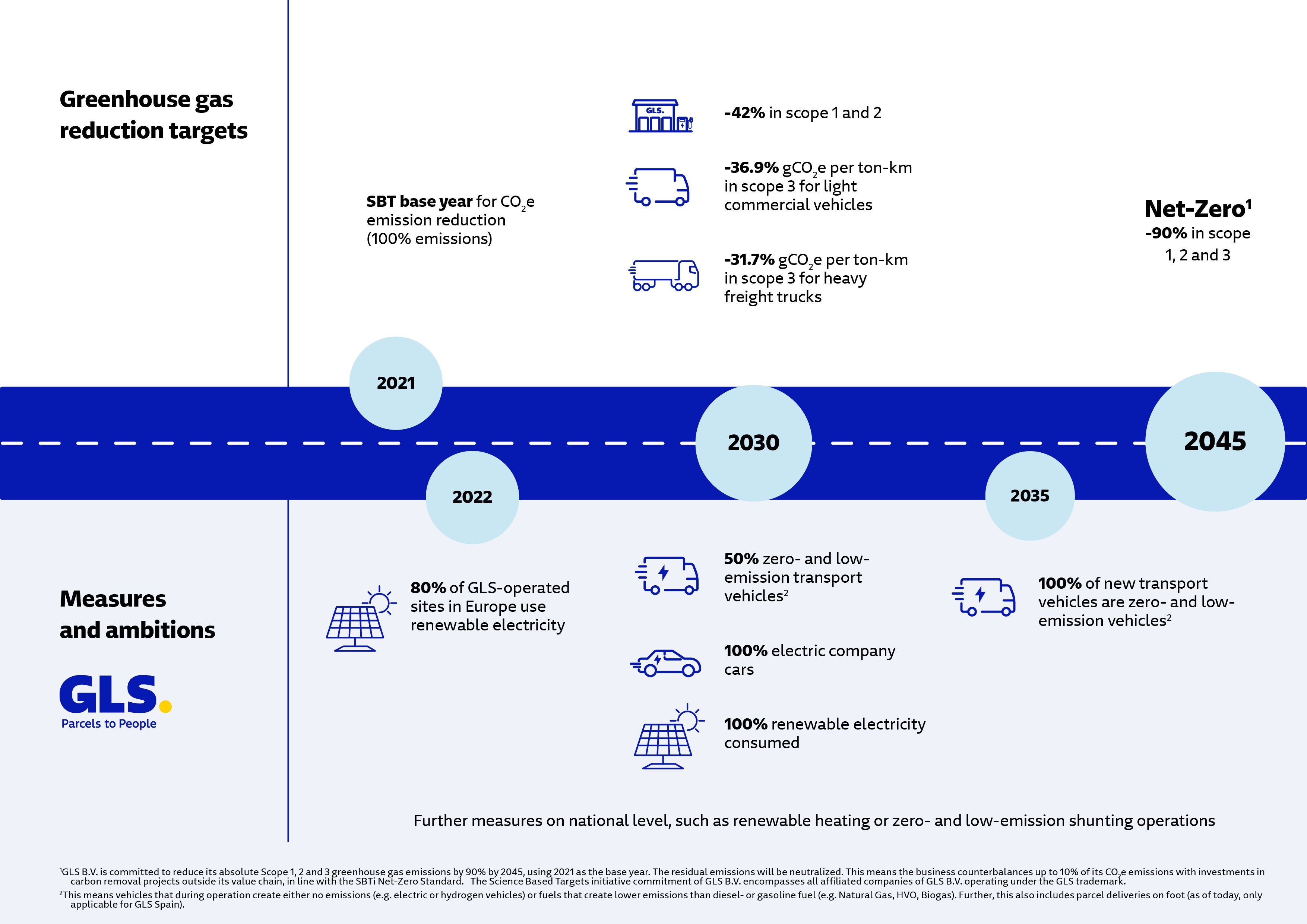
How we will achieve net-zero* by 2045
Since road transportation services are GLS Group's core business and accounted for approximately 90% of the company's carbon emissions in 2024, reducing emissions in this area is central to our transformation efforts.
As part of our group-wide environmental strategy, we are focused on converting the predominantly subcontracted transport fleet to electric- and low-emission modes**, such as electric vans, cargo bikes, and the usage of biofuel and biogas. Measures for introducing these vehicles vary by country, tailored to local market conditions to maximise individual impact. To support this fleet transformation, we are investing in infrastructure upgrades at our depots, including the installation of charging infrastructure, enhancements to the power supply, and the implementation of load balancing systems and electricity meters.
Furthermore, we are upgrading our existing depots and hubs to reduce our CO2e emissions by increasingly using renewable electricity, installing photovoltaic systems and implementing electric vehicle charging infrastructure. We are also replacing fossil heating systems with renewable options, such as electric heat pumps.
We take a holistic approach to these challenges, seeking solutions both within our corporate boundaries and in collaboration with our business partners.
GLS' science-based targets
GLS B.V.'s* science-based targets are published on the SBTi target dashboard under “General Logistics Systems B.V.”.
How GLS calculates its emissions
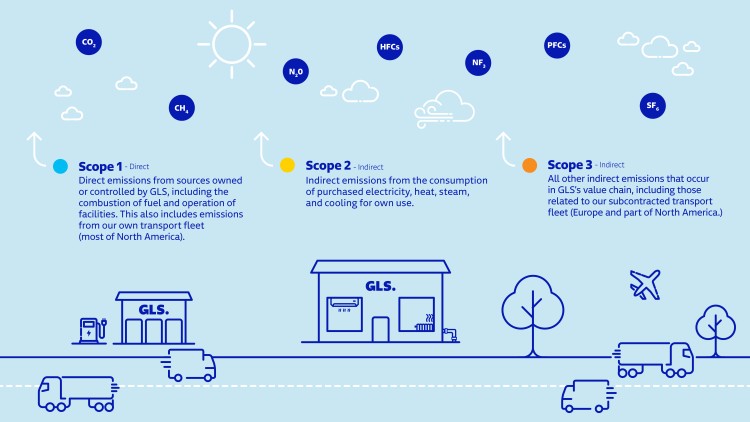
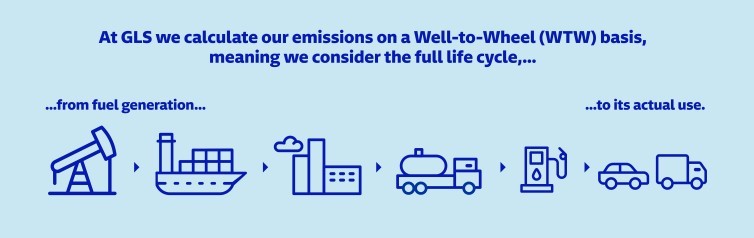
At GLS we report our carbon emissions Group-wide in accordance with the Greenhouse Gas Protocol .
We include Scope 1, 2, and 3 emissions in our calculation and disclose our emissions in carbon equivalents (CO2e), which means that other greenhouse gases (e.g. methane) are also considered.
Supporting documents
*GLS B.V. is committed to reducing its Scope 1, 2 and 3 greenhouse gas emissions by 90% by 2045, using 2021 as the base year. Residual emissions will be offset. This means that the company will offset up to 10% of its residual emissions through investments in carbon capture projects outside its supply chain, in accordance with the
SBTi Net-Zero Standard . The SBTi-approved emission reduction targets, set by GLS B.V., apply to all companies owned by GLS B.V. and operating under the GLS brand. GLS Poland is a subsidiary of GLS B.V. and is included in GLS B.V.'s SBTi commitment. Group SBTs are monitored at the consolidated Group level and do not represent individual targets for subsidiaries, such as GLS Poland. These companies may perform above or below the Group targets, while the Group as a whole remains compliant with the overall consolidated Group SBTs.
**This means that vehicles consume electricity or fuels whilst in operation, the combustion of which results in lower emissions than diesel or petrol (e.g. HVO, biogas and other types of gas such as LNG, LPG and CNG).
*** Achieving these targets includes emissions at the Earth’s surface and carbon capture from bioenergy feedstocks (e.g. peat).