When you launched your online store, you probably thought that everything depended on attracting visitors to your website and converting them into sales. But as your business has grown, you may have realized that selling only through your ecommerce site can become a bottleneck. Competition is fierce, advertising costs are rising, and every day you get more questions like: “Do you also sell on marketplaces?”
This marks the beginning of a new phase, full of opportunities but also questions:
- What exactly is a marketplace?
- Should I choose a specialized or a general marketplace?
- How do I know which one fits my product and strategy?
This article is designed to help you understand the different types of marketplaces and how they can be strategic partners if you want to grow your business in Spain or internationally.
What Is a Marketplace and Why Are They Key for Selling Online?
A marketplace is a digital platform that connects sellers and buyers in a single virtual environment. Unlike your own online store, a marketplace acts as an intermediary, handling parts of the process — payments, visibility, logistics — and allowing you to reach a large audience already accustomed to shopping there.
More and more ecommerce businesses choose to complement their online store with a presence on marketplaces, especially when they want to expand internationally or test new markets. In many countries, a marketplace is not just an option it is the preferred buying channel for digital shoppers.
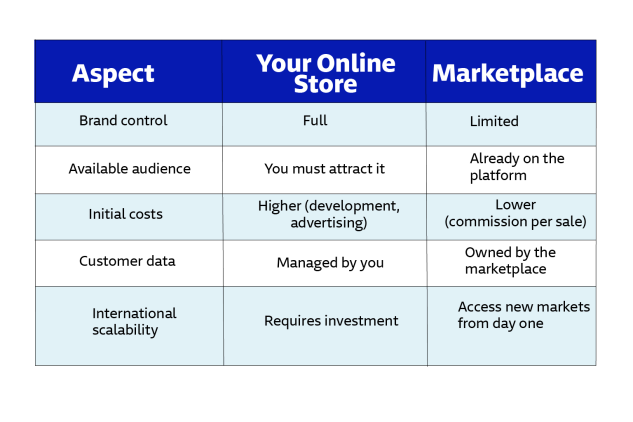
Differences Between a Marketplace and Your Own Online Store
Although both channels allow you to sell online, the differences are significant:
Types of Marketplaces by Business Model
Although all marketplaces connect buyers and sellers, they do not all operate in the same way. Here are the main categories based on their commercial focus.
B2C, B2B, and C2C Marketplaces: Examples and Differences
Marketplaces differ not only in what they sell but also in who they sell to. This classification is essential for defining your marketplace strategy:
- B2C (Business to Consumer): Companies sell directly to end consumers. The most common type in ecommerce, including Amazon and El Corte Inglés Marketplace.
- B2B (Business to Business): Focused on sales between businesses. Ideal for industrial products, wholesale, or professional services.
- C2C (Consumer to Consumer): Allow individuals to sell to other individuals. Initially for second-hand products, but many professional sellers are now active on these platforms.

General vs Specialized Marketplaces
Another way to classify marketplaces is by scope or thematic focus:
- General marketplaces: Offer products across multiple categories, from fashion to technology or groceries. Strength lies in volume and broad shopping experience.
- Specialized marketplaces: Focus on a single category (e.g., sports, home decor, gourmet food), attracting a highly targeted audience with strong product affinity.
Vertical and Horizontal Marketplaces: Definition and Differences
This classification relates to the structure and depth of the offerings:
- Horizontal marketplaces: Aggregate products or services from multiple sectors, prioritizing variety.
- Vertical marketplaces: Focus on a single category or need, often providing a more refined user experience, specific filters, and tailored services.
Leading Marketplaces in Spain
Spain is a very active ecommerce market. Although specialized options continue to grow, the most popular marketplaces share some common features:
- Easy integration with ecommerce platforms.
- Built-in visibility and advertising tools.
- Integrated logistics options or partnerships with carriers like GLS to cover the last mile.
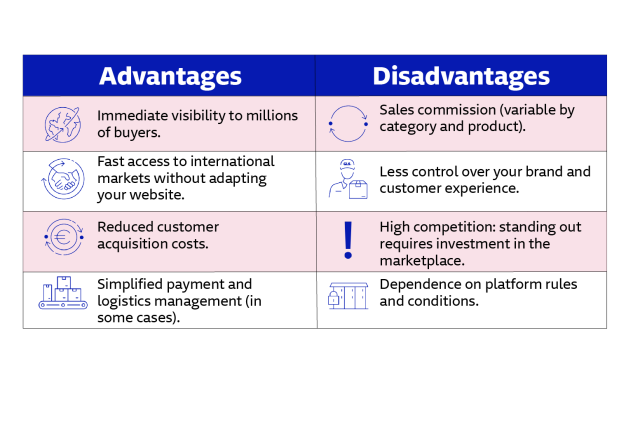
Advantages and Disadvantages of Selling on Marketplaces
Before starting, it’s important to have a balanced view of what they offer and require:
Which Type of Marketplace Is Best for Your Ecommerce?
There is no single answer. It depends on:
- Your product type and level of specialization.
- Whether your target audience is in Spain or if you aim to expand internationally.
- Your logistics capacity (inventory, returns, delivery times).
- The profit margin available to cover marketplace commissions.
Questions to help you decide:
- Are you aiming for fast volume or more specialized sales?
- Do you have enough margin to cover commissions?
- Does your ideal customer already shop on marketplaces?
- Do you want to scale internationally without redoing your entire store?
For many ecommerce businesses, the ideal combination is: your own online store as the operations hub and multiple marketplaces as acquisition and expansion channels. This allows you to diversify your digital presence, adapt to each country’s shopping behavior, and scale faster.
Additional Resource: Start Selling Globally
GLS Spain has launched “Start Selling Globally” , a free guide where you’ll find key steps to internationalize your ecommerce, manage logistics, and choose the most suitable channels, including marketplaces.
A practical resource you can consult anytime.
Download it now!